The Leadership Journey Podcast 15: Jonathan Rea (2)

about_15

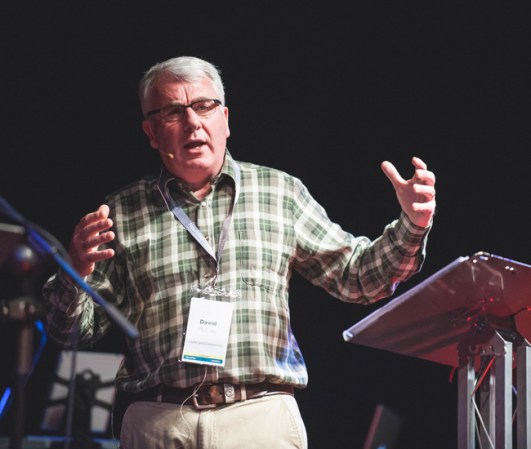
This week’s podcast is the second part of the interview with Jonathan Rea, Creative Director of New Irish Arts.

In the second part of the interview Jonathan describes the impact of a serious health crisis and – in a section of the interview that will be of special interest to people involved in church music – he discusses some of the things he listens for in choosing new songs.

As you listen, you may like to reflect on these questions:

  1. If you are involved in church music, what do you think of Jonathan’s view that what we sing needs to combine theology and emotional engagement? Do you tend to one side or other?
  2. Are you the kind of leader who is more likely to have a 5 year plan, or is your leadership more about responding the opportunities God gives you?

The Leadership Journey Podcast 14: Jonathan Rea (1)

about_15

This week’s guest on the Leadership Journey podcast is Jonathan Rea, the Creative Director of New Irish Arts, a charity working to be a Christian presence in the arts and an artistic presence within the Church.

In this first part of the interview, Jonathan discusses his journey, both as a Christian and as a musician – two paths that have obviously converged in his life and work, not least as he has taken on leadership of New Irish Arts.

  • Jonathan mentions the potential of peer influence, specifically in his friendship with Keith Getty: how would you assess your peer relationships in this regard?
  • As a leader, are you more of an entrepreneur or someone who picks up an initial idea and runs with it?


The Leadership Journey Podcast 13: Harold Miller (2)

shop

This week’s episode continues the interview with Bishop Harold Miller (you can catch up with part one here).

Harold talks about his season of theological education (and the influence of Michael Green) and how God led him into the various stages of his ministry. He also talks about his vision for leadership and his strong aversion to sectarianism.

Watch out for mention of leaders’ ‘Popeye moments’ and for a remarkable story about tossing a coin, as well as a moving quotation from Helen Roseveare.

As you listen and reflect on your own leadership journey:

  • How has God led you into the various places where you have led?
  • What are you passionate to see changed?

The Leadership Journey Podcast 12: Harold Miller

shop

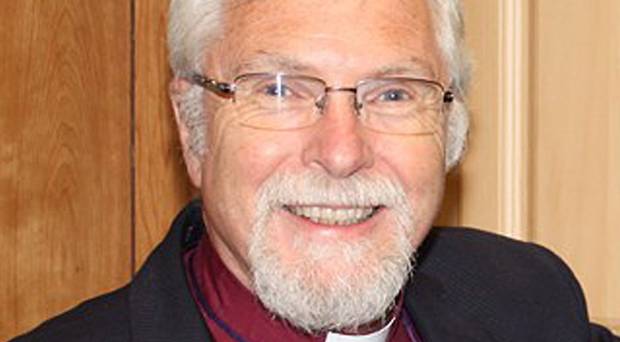
The guest this week is Harold Miller, Bishop of Down and Dromore in the Church of Ireland.

In this first part of his interview Harold talks about his conversion experience and the early stages of his growth as a leader while involved in the Christian Union at Trinity College, Dublin (his years there coincided with a remarkable batch of future leaders and missionaries).

He also talks about the role of an Anglican Bishop and the importance of leaders having other people around them.

Here are some questions for you to reflect on as you listen to Harold’s interview:

  • Harold mentions a number of key mentors: what mentors are helping to shape you, and are you building into the lives of other, younger leaders?
  • Harold talks about ‘holes in the cheese’: as you think about your own church tradition, where are some of the gaps?

THE LEADERSHIP JOURNEY PODCAST 11: Alistair Bill (part 2)

revd-alistair-bill-saintfield-road-presbyterian

This week’s episode of the podcast features part two of an interview with Alistair Bill, minister of Saintfield Road Presbyterian Church in Belfast (you can listen to last week’s episode here).

Alistair talks about his ministry which has spanned over three decades and has taken him to both sides of the Irish border and he discusses some of the important things leaders need to be aware of.

Leaders need to pay attention to context (‘the leader’s first task is to define reality’ – Max Dupree), to God’s call, the ‘big picture’, and the importance of leading as a team.

THE LEADERSHIP JOURNEY PODCAST 10: Alistair Bill (part 1)


revd-alistair-bill-saintfield-road-presbyterianAlistair Bill has been minister of Saintfield Road Presbyterian Church in Belfast for almost 24 years. In this week’s podcast – the first part of a two-part interview – Alistair talks about his early years, including how he came to faith through the ministry of Arthur Blessitt (remember him carrying his cross around Northern Ireland in 1972, and the smiley face stickers? – he is now into his 50th year of carrying the cross!) and how he began to sense God’s call into vocational ministry.

In part 2 of the interview (next week) Alistair talks about his years of ministry in Greystones, Monaghan, and his current church – Saintfield Road: he also shares some of the important leadership lessons he has picked up along the way.

Remember that you can subscribe to the podcast via iTunes, where you can also catch up with previous episodes, including interviews with Derek Tidball and David McClay.

Here is this week’s interview:

The Leadership Journey Podcast 9: David McClay (part 2)

sligo-30-650x550This week’s episode picks up David McClay’s story and David talks about his ministry at Willowfield Parish Church in East Belfast. He shares some of his thinking about the Church in 21st century Northern Ireland (though there is plenty of potential application further afield). In days of challenge and opportunity, David’s conviction is that the Church needs to preach biblically, evangelise intentionally, and to be humble – we need to bend the knee to Jesus.

My sense is that a lot of people out there in society are very open to have conversations about Jesus – David McClay.

The Leadership Journey Podcast 8: David McClay (part 1)

sligo-30-650x550Archdeacon David McClay is Rector of Willowfield Parish Church in East Belfast. Along with his wife, Hilary, he leads the work of New Wine Ireland.

In this week’s episode of the podcast, David talks about his early years of coming to faith, beginning vocational ministry in the Church of Ireland, and some of the formative influences in his life . He also talks about the painful experience of losing his first wife when he was still a young minister, and how God worked in his life as a result of that experience.

(Part two of the interview will be next week).

The Leadership Journey Podcast Episode 7: Derek Tidball (part 2)

49

This week’s episode continues the conversation with Derek Tidball; Derek talks about some of the personal lessons he has learned along the way as a leader, we discuss the difference between having high standards and being a perfectionist, and between being a hard worker and a workaholic!

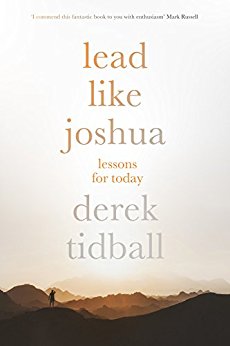
If you’d like to know more about Derek’s book on Joshua, here is my summary of it and you can pick up a copy for yourself on Amazon and other outlets.


The Leadership Journey Podcast Episode 6: Derek Tidball (part 1)

49
The guest on the next two episodes of the podcast is Dr Derek Tidball. Derek’s leadership roles have included ministry in a couple of Baptist churches as well as being Principal of London School of Theology: he is also the author of many books, including his most recent book, Lead Like Joshua.

Podcast supplement: reflect on your leadership journey

One of the ways you might like to follow up with this week’s podcast on the leadership journey of Moses is to reflect on some of the things that have contributed to your own leadership journey.

Keep in mind that while Moses’ story fits neatly into three stages, your journey may have more phases. Look out for events and times that have marked turning points between phases. Use the second template (or your own variation on it) to reflect on your own story.

 Key stages

Formative years

Exile years

Leadership years

Turning points Intervening against the Egyptian Meeting God at the edge of the desert Striking the rock
Defining moments Standing up for the Hebrew slave Choosing to intercede
Important people Mother, sister, Pharaoh’s daughter Wife, father-in-law Aaron, Joshua
Crucial decisions Deciding where his allegiance lay Defying Pharaoh and leaving Egypt
Times of testing Tests faced by his people and family The loss of his vision Complaints of the people
Notable successes Courage of others Signs and wonders
Regrettable failures Rejection Striking the rock
Life lessons Sense of injustice and of identity Experiencing the mighty hand of God
Sense of calling Choosing to stand with the Hebrews Call episode in chapter 3,4
Key stages Stage 1 Stage 2
Turning points      
Defining moments      
Important people      
Crucial decisions      
Times of testing      
Notable successes      
Regrettable failures      
Life lessons      
Sense of calling      

Happy New Year!

MicrophoneHappy New Year from Your Leadership Journey! May 2018 be a year of growth and fruitfulness in your leadership.

After a short break, the Leadership Journey Podcast will be back this week (Tuesday) and in this week’s programme I will be talking about the leadership journey of one of the most significant leaders in the Bible: Moses, who has been described as ‘the most important and celebrated character in the Hebrew Bible’.

As the year unfolds, the podcast will include interviews with a range of leaders, including Bishop Harold Miller, Phil Emerson from Emmanuel Church in Lurgan, former head of the NI Civil Service, Sir Nigel Hamilton, and prolific author and former Principal of London Bible College, Dr Derek Tidball.

The weekly episodes will be posted here and you can also subscribe on iTunes.

The Leadership Journey Podcast Episode 4: Alan Wilson

Microphone

Episode 4 of the podcast features the first of the leader interviews where the series will invite a range of leaders to talk about their leadership journeys. In this episode, Alan Wilson, host of the podcast, finds himself on the other side of the microphone, with Gemma Brown asking the questions.

During the course of the interview, he discusses issues such as mentoring, leadership styles and crucibles.

Several books are mentioned:

  • Resilient Ministry (Burns, Chapman and Guthrie)
  • Lead like Joshua (Tidball)
  • Courageous Leadership (Hybels)
  • Isolation (Trebesch)

It’s a longer that normal podcast, so get yourself a warm drink and a mince pie and settle yourself by the fire. Or – if you are an outdoors type, put on your running/walking shoes/skis and head out for an hour!

There’s no podcast scheduled for next Tuesday, but we plan to be back on January 2 with a programme about the leadership journey of Moses.

Here is the link to this week’s episode (and don’t forget you can subscribe on iTunes). Happy listening and have a great Christmas!

SaveSave

Leadership 101: Call, character and competence (4)

keys-leadershipThe previous post started looking at leadership competence, the third factor that we can draw from the little vignette on David’s leadership in Psalm 78.

I suggested these eight leader competencies and the post reflected a little on the first four.

  • Determining the mission
  • Establishing vision
  • Maintaining values and culture
  • Strategic and operational planning
  • Managing change
  • Communication
  • Problem solving
  • Team building

What about the others?

Managing change

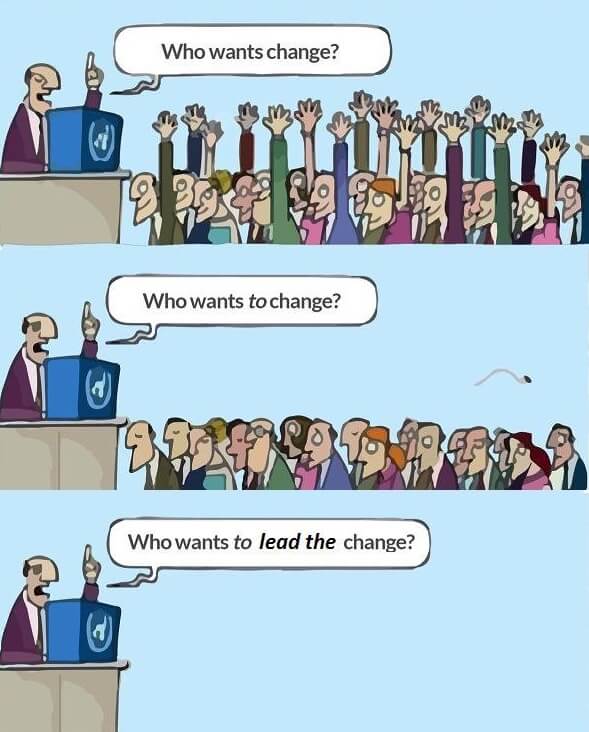
They say that some of the only people who welcome change are babies with wet nappies (diapers, if you are reading on the far side of the Atlantic). While that’s an exaggeration, but it’s worth looking at this:

who-wants-change-who-wants-to-change

I’d seen the first two parts of this, but just found the third element: leaders beware!

Even if it is not always welcome, change is inevitable. Some organisations are agents of change (fifteen years ago, who thought we’d be using the same device to make phone calls, read emails, listen to music and shoot time-lapse video?). Others need to learn to adapt to change.

To put it somewhat technically, change is needed when there is a discrepancy between the current state of things and how we want them to be. What makes it difficult is that it means something has to be left behind. Business writers Ron Heifetz and Martin Linsky suggest that ‘people do not resist change, per se. People resist loss.

Which, of course, threatens to put he brakes on any proposed change. That’s until the potential gain of the change outweighs the perceived loss; or until anxiety about what will happen if we change is outweighed by anxiety about what will happen if we fail to change. For example, it may only be when the fear of having to close their doors weighs more heavily on the members of a congregation than the fear of what it might mean to make changes to the format of their services, that that congregation will be willing to change – though I suspect it would be possible to find examples of churches whose commitment to perceived ‘faithfulness’ meant closing the doors rather than changing anything.

James Lawrence uses railway analogy in describing four groups of people who respond differently to change. Radicals are the track layers, out in front, impatient for change. Progressives are the engine drivers who take a positive view of change, but realise that it needs to be worked through carefully. Conservatives are the fare-paying passengers who are wary of change but may be persuaded. Traditionalists are the brake van: they fear change.

Leaders will have to work with each of these four groups, not least in churches. For some of the radicals, change may never come quickly enough, or in big enough doses. At the other end of the spectrum, for some traditionalists, any change is a bridge too far. It’s the groups in the middle that can be reasoned with. Sometimes some of the radicals may need to be allowed to leave. The traditionalists, at least the older ones, are unlikely to leave and the leader will have to assure them that they will be cared for and valued even if they don’t like the direction the church is going.


Communication

Good communication is the competency that undergirds all of the other elements of effective leadership. Poor communication makes assumptions, lacks clarity, or fails to make the case for the vision, the mission or the change that the leader wants to implement.

I think one of the most basic failures of leadership (of which I have been guilty, and I have seen it happen) is the failure to communicate with the people who are most likely to be affected by any proposed change. It simply alienates people and diminishes the leader’s credibility with the followers.

Communication can be quite a complex science given the number of ‘moving parts’. It involves a communicator, a message, and an audience. The process of communication can go awry at any of these points. There can be an unclear message – say a muddied sense of mission, a clumsy communicator – say who understands neither the message nor the audience, or a distracted audience whose attention is being pulled in a hundred directions and who are only too ready to put their own interpretations on what is being said and fill in the gaps where things are unsaid.

The leader needs to be aware of these challenges and ensure that the message if both accurately sent and accurately received.


Problem solving

Leadership is unlikely to take place in the absence of problems. Businesses feel the impact of the global economic climate. Sports teams feel the impact of loss of form or of injuries to key players. Churches are not exempt from the winds of cultural change or from the internal factionalism that would be better not there, but too often is. Organisations feel the pressure of a downturn in income or the turnover of key staff.

Problems need to be clearly identified and properly understood. The more complex the problem, the more important that the leader understands its multiple dimensions. Perhaps when Mr Jones walked out in protest to the ditching of the church organ in favour of a guitar, there was more to it than met the eye; a quiet word might have revealed that he doesn’t mind guitars, but it was his great uncle who paid for the pipe organ to be renovated fifty years ago!

A range of solutions need to be drawn up and evaluated for their strengths and weaknesses. Leaders need to be smart enough to anticipate possible pitfalls with their preferred solutions.

The best solution should be identified, agreed on, especially by those who are most likely to feel the impact, clearly communicated, and implemented.


Team building

Not every leader may possess all of these skills in equal measure. A visionary leader may lack the patience to work out the careful steps needed to implement the vision. He or she may be impatient with the speed of change and the resistance of the traditionalists. There is a fairly obvious case to be made for leadership teams where team members complement each other as they bring their participant strengths and leadership styles to the table.

And of course team means another dynamic in the leadership process. A team needs to be led. Its members need to be managed. It needs to have healthy systems of communication.

And what is a team, anyway? Is it different from a task group or from a committee?

(To be continued).


Leadership 101: Call, character and competence (3)

keys-leadership

Over the past few weeks, the blog has been reflecting on a leader’s call and character. A third important factor in good leadership is competence. While calling gives a leader a sense of conviction about his or her leadership, character helps provide integrity and build trust. But leadership also calls for some skills.

What about a leader’s competence? Here’s a list of eight things that need to function well for leadership to be effective.

  1. Determining the mission
  2. Establishing vision
  3. Maintaining values and culture
  4. Strategic and operational planning
  5. Managing change
  6. Communication
  7. Problem solving
  8. Team building

There is a lot that could be said about each of these eight skill areas. I’m going to take four this week and leave the others till next week.

Determining the mission

If you’re a leader, you need to know why your organisation, your church, or your team exists. Church leaders are hopefully going to see the mission of their particular church as one part of the biblical mission of Christ’s Church, even though they need to figure out the specifics of being a particular church, in a particular place, at a particular time. One way to sharpen your thinking is to ask what would happen if your church went out of business!

In their book on ‘mission drift’ Greer and Horst underline the importance of clarity and intentionality in defining mission. Their concern is primarily for Christian organisations that drift from the moorings of their original intention: a clear understanding of mission allows an organisation to stay focussed and helps guard against drift.

As Walter Wright suggests, a mission statement clarifies ‘who we are’ and provides a goal by which the organisation’s effectiveness can be measured.


Establishing vision

Closely connected with mission is vision: in fact, it’s easy to get the two ideas mixed up. Perhaps we can think of mission as what we do while vision is where we hope to arrive: it’s a picture of a desired future.

While we’re talking about it, can I share one of my pet nitpicks about vision?

How many times have you heard someone quote Proverbs 29:18 – ‘where there is no vision the people perish’ – in an attempt to persuade you of the biblical case for having a mission statement? Sorry, but I don’t think the verse is using the word in the way it gets bandied about by leader- types: the point is that when there is no prophetic vision (no one is hearing from God), there will be problems.

None of that should say that a sense of vision is not important. Some leaders are blessed with an ability to picture a better future for a church or an organisation, and that picture helps move the organisation along in its mission.

Bill Hybels is an example of a strong visionary leader. He’s about to hand over the reigns at Willow Creek Church, but not having overseen the church’s birth and its growth – not least in its influence around the world. For Hybels it started when a Bible College professor painted a picture of the early church in Acts.

Hybels describes vision as ‘the leader’s most potent weapon’. The leader’s task is to see the vision, to personify it and to communicate it.

For all that may be said about the value of an inspiring vision, it’s’ worth noting Derek Tidball’s caution in his new book on Joshua the leader: ‘Passion and visions may well be God-given, but they may equally … be misguided.’


Maintaining values and culture

Perhaps you’ve come across the saying that ‘culture eats strategy for breakfast’. I may not have put it like that, but I think it’s a valid claim. We’ll get to strategy in a moment, but we need to recognise that strategy is going to be hamstrung if our organisation or our church lacks the right kind of culture.

Culture is the amalgam of beliefs and assumptions, ‘the way we do things here’ that shape how things are. It’s linked with values, but here’s where it gets tricky. You can have plaques on the wall listing the most wonderful-sounding values, but if those values are not really owned by the members of the organisation, that remain no more than noble aspirations.

Walter Wright suggests that ‘every organization has a hidden culture that has developed over the years that controls what is actually done regardless of the values we espouse’. How many churches say that prayer is one of their key values, but struggle to get people to turn up at a prayer gathering? Might there be a disconnect there?

This all means that the leader’s task is to reinforce the desired values of the organisation, thereby shaping the culture and thereby enabling the strategy to take shape.


Strategic and operational planning

It’s not enough to have a vision or even a clear sense of mission if you don’t have a clue about how to get from A to B. Mission without implementation is fairly futile.

Walter Wright (yes, him again – check out his book Relational Leadership) outlines a 10 step process towards implementing a vision. Each step consists in exploring a question. The first four relate to strategic planning, the next four to operational planning, and the other two are the review process.

  1. Who are we?
  2. What is important to us?
  3. Where in the world are we?
  4. Where do we want to be?
  5. How should we do it?
  6. How should we do it?
  7. When will we do it?
  8. Who will do it?
  9. How are we doing?
  10. Was God pleased?

(By the way, how many committee/team meetings would be a lot more efficient if each agenda item included questions 4-8?)


That’s enough for now – we’ll leave the other four competencies for next week. Though meantime it’s worth pondering whether every leader will necessarily have each of these abilities, whether they have them in equal measure, or whether one implication of this is a recognition of the importance of team.

Leadership 101: Call, Character, and Competence (2)

building-character

This is a follow on from the post that began discussing the call, character and competence of a leader. There is one more part to come in this triad.


That there should be a discussion of the character of a Christian leader should hardly be surprising, given the significance of the theme of character in Scripture and the Christian tradition.

James Lawrence offers a simple definition of character (‘who you are when no one’s looking’) and suggests that it is most clearly seen in small, day-to-day things, when the leader is under pressure, and when the leader is in private. Among the reasons why character matters is that ‘without credibility … a leader will have no one to lead’ and that it is character issues that most often lead to derailment.

Then there is this – from Os Guinness:

As traditionally understood, from the Hebrews and Greeks onward, character is the inner form that makes anyone or anything what it is – whether a person, a wine, or a historical period. Thus character is clearly distinct from such concepts as personality, image, reputation or celebrity. It is the essential “stuff” a person is made of, the inner reality and quality in which thoughts, speech, decision, behavior, and relations are rooted. As such, character determines behavior just as behavior demonstrates character.


It has been suggested that much of the Old Testament account of the ancient Hebrews could be viewed as ‘a story of character and character formation’. Both Old and New Testaments exhort the people of God to be obedient and holy. Special application was made to the OT kings who were to be on their guard against the temptations of wealth, horses and the accumulation of wives. In the New Testament, alongside Jesus’ general teaching in places such as the Sermon on the Mount, specific qualities are highlighted in relation to spiritual leaders.


Yet both biblical and empirical evidence remind us that while we might be disappointed at contradictions in leaders’ character, we should not be surprised. While many of the OT kings are condemned for their character failure, there is also a recognition that essentially good leaders can also be flawed.


The biblical record has a lot to tell us about the tests of character: whether it’s Joseph and David, two leaders who meet sexual temptation with contrasting responses, or Jesus himself, whose faithfulness in the face of desert temptation contrasts with the failure of his ancestors at the time of Moses.

Both adversity and prosperity reveal a leader’s character and draw attention either to strengths or to weaknesses that will have to be addressed.

Bill George noted that some of the leaders who get derailed during the course of their leadership journey are not necessarily bad leaders: they get caught up in their own success. I spoke to a leader who shared (with searing honesty) about a phase in the early days of his ministry when his public stock was soaring, but his home life was threatening to derail him.

It seems that success can be more dangerous than failure!


There are several ways in which character has a shadow side. For one thing, as Parker Palmer puts it, a leader can project either light or shadow and leaders need to pay attention to their shadow side, something that calls for a degree introspection that is not always present in leaders. Failing to understand our own failings, according to Palmer, leads us to find ways in which we can make someone ‘out there’ the enemy and so we become leaders who oppress rather than liberate.

Another, perhaps more subtle problem is that our strengths sometimes have shadow sides. For example, resilience can easily become stubbornness; discernment can become judgmentalism. Yesterday’s reflection on calling noted that a strong sense of call can have a shadow side when it means that a leader is so committed to the task of leadership that spouse and family are neglected.

Samuel Rima observed that,

The personal characteristics that drive individuals to succeed and lead often have a shadow side that can cripple them once they become leaders and very often causes significant failure.

In talking with several leaders in the course of my research I noticed some specific examples.

  1. The self-reliance that can lead to the vital quality of resilience can also make it challenging for a leader to relinquish control. The leader may become stubborn or controlling.
  2. The ability to confront (not always a comfortable task) allows a leader to deal decisively with issues, but its shadow side can become harshness.
  3. Similarly, passion gets things done. It is those leaders with passion and drive who are likely to break new ground or thrive in challenging situations, but the shadow side is the risk of burnout or the risk of collateral damage caused to others on the team.

There is this, from Leighton Ford:

Every leader has a ‘shadow’ side, like the dark side of the moon – areas that are disguised, or perhaps explored but unrecognized. I am convinced that our leadership will be stronger and the dangers of collapse lesser if we become aware of these dark areas and bring them into the light early.’


I think the best leadership is that which flows from who the leader is: in that sense it is authentic leadership. I use the term with a degree of caution. There is no doubt that people (perhaps especially younger people) are drawn to authenticity. But its shortcoming is that its reference point appears to be internal while the reference point to character is external.

So perhaps I should say that the best Christian leadership is that which flows from the authentically God-shaped character of a leader.

Which means that all of us ought to be on a constant growth trajectory.

A young church leader asked me once if I thought a lot of Christian leaders have a gap between their public persona and their private life. It was a great question and while I can’t quantify the answer, it has to be some kind of a yes!

Those of us who have some kind of public persona, whether as leaders or preachers, often come across as those who have it all together. According to our persona, we never worry (because we roll our burdens onto Jesus), we are patient and kind, our wives worship the ground we walk on and are so grateful to be married to such wonderful people, we never get angry, all the prayers we pray in our rich prayer lives are answered, we never have any doubts, questions or fears. The calm conviction that we express so eloquently from the pulpits we grace characterises every waking moment.

Whereas if only people knew that our wives sometimes despair of us (I’m reminded of the incident which Paul Tripp recounts – against himself – where he told his wife that 95% of the women in his church would love to be married to a man like him: she declared herself in the 5%!); or that some of us struggle to pray, that we don’t always find our souls nourished by our Bible readings, that our private spiritual lives may not have the vitality everyone assumes, that we get anxious, that we feel guilty, that we may lie awake at night fretting over one thing or another, that we get more angry over some things than we should, that the fruit of the Spirit is not always evident in our lives, that we have questions about unanswered prayer, that we have regrets, that we sometimes get more wrong in our leadership than we get right, we experience moments of self-doubt and self-loathing, that when we cut we bleed, that we sometimes struggle to forgive, or that we have times when we even wonder if we should really be doing this stuff.

In short – we are not perfect, nor will we be until we see Jesus and we are made like him.

None of this should be an excuse for hypocrisy, or for inattention to the cultivation of spiritual character. It should be an incentive for growth.

Ministry and leadership are a gift and a privilege but should not be understood as a ‘get off the hook’ pass in terms of the need to grow in character.


We’ll get to the third ‘c’ (competence) in next week’s post.

But don’t rush to get there just yet – not least if you are a younger leader. Character matters. Failure to pay attention can result in leader derailment with all that entails.
Leadership 101: Call, Character, and Competence (1)

gods-call-to-leadership

In his book on staying fresh in Christian leadership, Paul Mallard starts by reflecting on how Psalm 78 refers to David:

[God] chose David his servant
and took him from the sheepfolds;
from following the nursing ewes he brought him
to shepherd Jacob his people,
Israel his inheritance.
With upright heart he shepherded them
and guided them with his skilful hand.

He notes these three things:

  • Conviction – the awareness that David had of being called and chosen by God;
  • Competence – David led with ‘skilful hand’;
  • Character – he shepherded the people with ‘upright heart’.

For the purposes of this post, I’d adjust Paul Mallard’s terms slightly, preferring ‘call’ to ‘conviction’.

James Lawrence, in Growing Leaders, also highlights the importance of discerning God’s call, developing Christ-like character, and cultivating competence.


All of the leaders I interviewed in my recent research referred in some way to calling. Ruth Haley Barton highlights the profound significance of being called by God: ‘it is a place where God’s presence intersects with a human life.’

Of course the most fundamental call is the call to believe in Christ and follow him. But within that call, one can find the seeds of a subsequent vocational calling. Some people have such dramatic conversion experiences that all of life is reoriented, a new direction and new priorities are set, and it can lead to a path of vocational leadership. The seeds of a call to leadership can be found in their conversion.

Often the call to leadership comes later. Sometimes it can be in the form of a ‘gradual awakening’ to one’s life purpose, though it can also happen in a moment of crisis, say in response to a stirring appeal.

Os Guinness has helpfully distinguished between two kinds of calling: what he calls an original, ‘ordinary’ calling, and a later, ‘special’ calling. The first is a sense of life purpose that comes in response to God’s call to follow him and its implications are lived out even if there is no direct, even supernatural, communication from God about a special calling.

He suggests that this latter ‘special’ calling has to do with tasks and missions given to individuals through some specific communication from God. Reggie McNeal says that ‘the call is the leader’s personal conviction of having received some life assignment or mission that must be completed’.


Much of the biblical narrative reflects the theme of God’s call. From the voice of God addressing the fugitive Adam and Eve in Eden, through the call of Abram to leave the familiar for the unknown, to the invitation of the Spirit and the Bride in Revelation, Scripture is the call of God to his people.

There are remarkable stories of individuals being summoned to a specific role in serving God. Think of Moses and his dramatic exchange with God at the edge of the Midianite desert. Or Isaiah and his life-changing vision of God’s holiness in the Temple. Or Saul who became Paul: the persecutor turned pioneer preacher.

But are these stories meant to be paradigms for today’s leaders? Can a Christian leader lead without having experienced the drama of a Moses- or Isaiah-like call? How might a leader sense the ‘call’?

Traditionally, within the evangelical world at least, there has been what you might term a tri-partite view of the will of God. Which means that God has a sovereign will – his plan for the universe, a moral will – how wants his people to live, and a specific will – his plan for an individual’s life. According to this understanding it is important to discover this specific aspect of God’s will: what is God’s plan for my life? The answer, it is suggested, lies in being able to line up several signposts so they are pointing in the same direction – the bullseye of God’s will. Typically these signposts will include elements such as Scripture, an inner sense of guidance, the advice of others, and, perhaps, circumstances. Mind you circumstances can be tricky things. For every divinely orchestrated open (or closed) door, one needs to remember that the circumstances were pretty conducive for Jonah in his escape from God’s call!

A few decades ago Gary Friesen suggested that some of the traditional evangelical understanding rests on shaky foundations and that an overly subjective sense of calling is hardly enough when it comes to surviving the heavy seas of ministry.

However it remains true that many leaders do experience a subjective sense of call, and find this sense of call a source of stability and confidence when they experience the turbulence of leadership. For example, a high profile leader told me that ‘there’s a real sense in which when I ever go through difficult times, the Lord has nearly always provided me with such a dramatic call to a particular role that I think, you can’t gainsay that, that actually happened.’

McNeal again: ‘Christian leaders certain of their call allow it to become the center of gravity for their life experiences.’


Perhaps the subjective sense of calling, for example as it’s expressed in Frederick Buechner’s famous comment about vocation being at the point where the world’s deep hunger and your deep gladness meet, needs to be balanced by a proactive involvement on the part of the Church and its recognised leaders. Have we grasped the implications of the Holy Spirit’s voice in community in Acts 13?


What is your view of calling? Have you a clear sense of conviction that you are doing what God has called you to do?


Leadership 101: The Making of a Leader

14_leadership-01

Last week’s post explored some of the questions around the definition of leadership. This week explores another question in the form  of one of leadership’s old chestnuts: are leaders born or made? Apparently a Google search for an answer to the question could fetch you millions of results!

If, with Thomas Carlyle, you subscribe to the Great Man theory of leaders, you’re likely going to say that they are born. They land on the planet, equipped with ‘the right stuff’ and lead simply by living.

It’s probably more than an academic question. After all, why bother with leader development programmes if leaders come pre-programmed to lead? Is there any value in leaders participating in such programmes? On the other hand, if leaders are made (at least in part), even those leaders who are born with an impressive array of leadership traits oozing from their pores will be able to benefit from training or coaching.

Warren Bennis described as ‘the most dangerous leadership myth’ the idea of a genetic factor in leadership. He claimed, instead, that ‘leaders are made rather than born. And the way we become leaders is by learning about leadership through life and job experiences.’

Not everyone agrees, with others suggesting that ‘it seems obvious that leaders are born different from their followers. It is not simply a matter of learning to lead’, or that leaders do need to have the ‘right stuff’ and that this is not equally present in everyone.

Interestingly, a couple of twin studies appeared to demonstrate that genetics do in fact account for part of the picture: around 1/3 of it in fact. Which means that, even if it’s only an inborn predisposition to leadership, leadership capacity is at least partly innate.


But what about the other 2/3 or so? The answer appears to have something to do with an emerging leader’s environment, including their experiences of life and leadership. In research literature these experiences include a range of things like hardships (and that term covers quite a range of events), ‘trigger moments’, bosses, religious experiences, unexpected opportunity, and so on.

One of the terms that has been used to describe some of the experiences that shape leaders is ‘crucible’. The term has been used particularly by Warren Bennis and Robert Thomas in their book Geeks and Geezers (later renamed Leading for a Lifetime: How Defining Moments Shape Leaders of Today and Tomorrow). A series of interviews they carried out with a range of leaders from different eras led them to conclude that every leader appeared to have undergone some kind of intense transformative experience. The nature of these ‘crucibles’, as they called them, were varied. Some were harsh, others much less so.

They came to see crucibles as tipping points ‘where new identities are weighed, where values are strengthened or replaced, and where one’s judgment and other abilities are honed. It is an incubator for new insights and a new conception of oneself.’

Robert Thomas went on to write more on the subject, classifying crucibles as crucibles of new territory, often at the start of a career, reversals and what he called suspension. Importantly, each type of crucible tests the leader’s resilience and what Bennis and Thomas called ‘adaptive capacity’.

It’s an interesting image (one which I have given a fair bit of time to in research with Christian leaders), though it may not tell the whole story of the making of a leader. An understanding of a leadership journey has to take account of more gradual influences: there is an accumulated wisdom to be gleaned along the way and sometimes growth in leadership is incremental more than it is dramatic.


One of the voices that has had much to say about the making of a Christian leader is Robert Clinton who proposed that God develops a leader over a lifetime and that three essential elements interact in the process. By that he means ‘processing’, in other words anything that produces a leadership lesson, time, and the leader’s response to the processing: obviously two leaders can experience similar things yet respond differently and how they respond will affect the impact of the experience on their development.

Reggie McNeal has written a challenging and insightful book on the shaping of a leader’s heart (A Work of Heart). He proposes that the shaping of the leader’s heart is a joint enterprise between the leader and God and it takes place in six different ‘arenas’ that McNeal describes as

  • Culture
  • Call
  • Community
  • Communion
  • Conflict
  • The commonplace

For some time it has seemed to me that the life story of Moses, for all its uniqueness within the Bible’s greater storyline, might serve as a paradigm to help leaders explore their leadership journeys.

His life falls neatly into three stages, each comprising forty years. The formative years are lived in Egypt where Moses grows up as a child of two cultures: cared for by his Hebrew mother and adopted by Pharoah’s daughter; the middle years, years of exile in Midian, are triggered by his clumsy attempt to establish himself as the rescuer of the Hebrews (how many leaders have had to retreat from grand plans because of clumsy presumption!); and it’s only at 80 that he reluctantly, and after much protest, embarks on his leadership years.

Along the way his life is shaped by the influence of others, he encounters God, he experiences the highs of leadership as well as its lows, he behaves well and he behaves badly. All of these things provide fascinating insight into the journey of a leader.


Over the past few years I have been particularly interested in some of the factors in the shaping of Christian leaders. My interest has been in the kinds of crucibles that leaders encounter and the role that these experiences play in the the shaping of their journey.

There are crucibles of new territory. Perhaps in the form of a dramatic, life-changing conversion, or in a call to Christian ministry. There are the steep learning curves, the ‘deep end’ experiences and the dramatic paradigm shifts encountered by some pioneering leaders.

There are reversals. Personal or leadership crises (and at times it’s hard to separate the two as one spills into the other). Opposition, conflict and disappointment all feature.

And there are crucibles of isolation, where leaders are set aside from their leadership roles, perhaps through illness. There is the loss of structure that comes with retirement. There are dark nights of the soul when hope is almost drained away.

All of these things – painful as many of them are – have the potential to shape a leader. At times they test or confirm the leader’s sense of call. At times they may highlight issues of character. At other times they force a leader to define who they are and what their leadership is about. Sometimes they serve to depend and strengthen the leader’s relationship with God.


Leaders don’t simply drop out of the sky, fully fitted with all they will ever need. For sure some of them seem to be born with a clear predisposition to leadership. But there is a journey of shaping and formation and the best leaders will go on learning.


Reflect on your own leadership journey:

  • What were some of the early indicators of your leadership gifting?
  • Who were some of the people who influenced you and encouraged you to get involved in leadership?
  • Can you identify clear stages of your leadership development? What were the major features of each of them?
  • What are some of the most significant things you have learned about leadership, and how have you learned them?
  • Have you encountered any crucibles? What were they, and how have they been part of your shaping?

Leadership 101: What, exactly is leadership?

leadership-bannerIt was none other than Machiavelli who suggested that ‘there is nothing more difficult to take in hand, more perilous to conduct, or more uncertain in its success, than to take the lead in a new order of things.’

But what, exactly is leadership? One count I saw had the number of definitions running act around 1500. It’s been suggested that, like the ancient proverb of the blind men attempting to describe an elephant, leadership has many aspects and none of them by itself appears to be an adequate definition. Warren Bennis suggested that it’s like beauty: hard to define, but you know it when you see it!


The understanding of leadership has developed across the centuries. In the middle of the 19th century, the focus was on leaders themselves, with Thomas Carlyle’s claim that the history of what has been accomplished in the world has essentially been the history of ‘the Great Men who have worked here’. It’s possible to trace the roots of the Great Man theory all the way back to Aristotle and his belief that social rank was determined through one’s superior virtues which, in turn, were the result of one’s birth.

Not unnaturally Great Man theory evolved into the Trait era (although the idea of traits is an ancient idea). The basic quest of students of leadership at this time was the attempt to identify which specific traits separated leaders from non-leaders. If people who became leaders were different from everyone else, what made them different?

The theory ran aground somewhat (at least for a while) when it was suggested that there was no consistent set of traits that distinguished leaders from non-leaders and, significantly, that just because someone is a leader in one situation does not make them a leader in another.

Trait theory never quite went away with some scholars suggesting that attempts to discard it have been too sweeping. Even if it is not possible to establish a definitive list of distinguishing marks, there appears to be evidence that there are some traits that make a significant contribution to a leader’s success.

Nonetheless, the focus of study shifted next to leaders’ behaviour. From one study emerged the idea that there were two dimensions to leadership: some leadership had a strong focus on the people it was leading while other leadership focussed more on the task at hand.

However this was not enough as people came to appreciate that no single style of leadership was universally the best style, regardless of the specific situation or environment. An understanding of leadership needed to take account of the situation in which leadership was being exercised.

Studies and theories continued to develop: from transactional leadership to transforming (and transformational) leadership, and from servant leadership authentic leadership.


Even if we’re unlikely to come up with a single, ‘correct’ definition of leadership that excludes all others, it’s worth making some kind of attempt!

For writers like John Maxwell, it appears to be the irreducible minimum:

Leadership is influence. That’s it. Nothing more, nothing less.

It’s simple and quite memorable, but probably leaves too many issues unresolved. Is all influence leadership? Does the influence of a TV advertising campaign qualify as leadership? Is there a difference between intentional and unintentional influence? To be fair, Maxwell has also been somewhat more nuanced in his subsequent claim that ‘the true measure of leadership is influence’.

Maxwell is not alone in highlighting influence as a key component of leadership. For example, Peter Northouse defines leadership as ‘a process whereby an individual influences a group of individuals to achieve a common goal’, while Howard Gardner describes leaders as ‘individuals who significantly influence the thoughts, behaviors and/or feelings of others.’ What’s interesting about this definition is that it allows Gardner to distinguish between direct leaders (think Churchill) and indirect leaders (think Einstein, whose influence was exercised through his ideas): leadership may be exercised by word and/or personal example.

I think these are all helpful, as long as we recognise the caution that has been noted by some scholars who have suggested that since few social interactions don’t involve influence, we’re not saying much when we say that leadership is influence!

David Starling suggests that ‘leadership is the act or task of making an intentional contribution toward the direction and motivation of a group in the framing and pursuit of a common purpose.’ He argues that good leadership is not an end in itself, but points beyond itself and promotes interests that go beyond its own.

It’s worth noting how his definition highlights both the element of intentionality and the idea of a commonly share goal towards which a group is moving.


Some of the writers I have mentioned are Christians, but it’s worth taking time to reflect on what makes Christian leadership Christian?

Carl Trueman suggests that trends in the culture have affected how the evangelical church has understood leadership. While accepting that Christian leaders can learn from wider aspects of leadership practice, he cautions that Scripture must determine Christian notions of leadership.

Albert Mohler, a fairly powerful leader himself, suggests that while an obsession with leadership in the contemporary church may be both necessary and understandable, this obsessive interest has nonetheless ‘served to distract the church from the nature of leadership as revealed in Scripture’, with Christians tending to draw lessons from various spheres of secular leadership rather than looking to the Bible.

James Lawrence calls for Christian leadership with these distinctives:

  1. It is founded in relationship with God as Trinity;
  2. It is rooted in the Bible and directed by the Spirit;
  3. It is marked by servanthood;
  4. It is shaped by the cross and resurrection;
  5. It is sustained by prayer;
  6. It is lived out personally as part of the community of the church.

‘Leadership,’ he says, ‘is a key factor in the spread of the gospel.’


There have been voices of caution both within the Church and more widely. Barbara Kellerman, a leadership insider who might be running the risk of biting the hand that feed her, critiques the leadership industry’s ‘leader-centrism’ with its implication that those who don’t lead don’t amount to much. It is not enough to focus only on the leader at a time when other factors, such as the rise of the follower, have gained significance, and leaders have less power than previously. In fact, she goes as far as to accuse the leadership industry of being ‘self-satisfied, self-perpertuting and poorly policed’!

David Starling, like Trueman and Mohler, warns about the tendency to swallow the secular concepts of leadership. He notes that for all the talk of ‘leadership’ in Christian circles, there are surprisingly few explicit mentions of the terms leader and leadership in the biblical text. However it is not that there are no leaders or that there are no other images associated with leadership tasks.


After all that, how should we define it?

I think that reaching a definition requires us to consider the relationship between the leader and the followers, the nature and means of the leader’s influence, and the establishment of the goal for which leadership is exercised.

Walter Wright (Relational Leadership) describes it as ‘a relationship in which one person seeks to influence the thought, behaviours, beliefs or values of another person’.

And here is my more clumsy attempt at describing a Christian leader:

A leader is someone who is intentionally influencing a group of people towards an agreed and beneficial goal: Christian leadership means doing that ‘Christianly’!


So what do you think? Here are a few questions to reflect on:

  • How important is leadership? Is it possible to either overstate or understate its importance?
  • What factors need to be considered in understanding what leadership is and how it is defined?
  • How might you define leadership?

← Back

Thank you for your response. ✨

Warning
Warning
Warning
Warning

Warning.

Crucibles of Christian Leadership (journal article)

IMG_8484

The Journal of European Baptist Studies has recently published an article I wrote which basically summarises my work on my thesis.

Here is the thesis abstract:

Among terms used to describe the events and experiences that contribute to the shaping of leaders is Warren Bennis’ and Robert Thomas’ ‘crucibles’. Their use of the term emerged from a series of interviews with leaders who had come of age in two distinct eras: all the leaders interviewed referred to a transformative experience that had contributed to their leadership. The aim of this research was to explore the significance of such experiences in the development of Christian leaders.

A sample of fourteen evangelical leaders was selected and each leader participated in an in-depth qualitative interview. Their experiences were classified using Robert Thomas’ three types of crucible: new territory, reversals and suspension. Analysis of the experiences demonstrated how crucible experiences had a part to play in shaping both the character and calling of a leader: at times crucibles functioned as intensified learning experiences in which a leader’s beliefs took on an existential intensity.

The emerging themes of character and calling are significant in both Old and New Testaments and the project reflected theologically on these. While crucibles may be significant features in the development of a leader, they do not tell the whole story: a range of factors and influences, some of which work in a more gradual way, are also part of a leadership journey.

If you’d like to read a copy, I’ve uploaded a PDF to the Academia website and you can access it here.

Leadership 101: Of writings on leadership, there is no end!

Quotefancy-1244279-3840x2160To borrow from an ancient preacher, ‘Of the making of [leadership] books, there is no end.’ Not exactly what Quoheleth had in mind, but doubtless he would have agreed.

Statistics from the publishing industry point to a relatively recent surge in interest in the subject. According to Barbara Kellerman, on average three books on leadership were published annually in the early 1980s; by 2012 the numbers were ‘somewhere in the stratosphere’.

No doubt the surge in interest reflects a more conscious awareness of the importance of leaders and leadership, concern, and a degree of handwringing at the apparent lack of good leaders, and all of it spiced up by the emergence of celebrity leaders across several domains.

Including the church.

Perhaps it’s unsurprising that the general interest in the subject is reflected in the culture. Of course, the relationship between ‘biblical’ leadership and more generally applicable principles of leadership can be complex. To what extent are Christians right to mine general leadership material for pearls of wisdom and to what extent is Christian leadership meant to be counter-cultural?

I’m planning to post a series of pieces on leadership over the next few months or so. Actually, I’ve got an idea (two, actually) for a book on leadership and I’d love it if some of you felt free to chip in on the various ‘Leadership 101’ posts as they appear.

Among the subjects I hope to feature are:

  • What, exactly, is leadership?
  • The making of a leader
  • Characteristics of effective leaders
  • Temptations of Christian leadership
  • The leader’s vision
  • The leader and the team

There will be other material on the leadership journey blog, but watch for the ‘Leadership 101’ posts on Thursday evenings – starting this evening.

‘Crucibles’: a conference for Christian leaders

In February I ran a seminar for Christian leaders at Edenmore Country Club. Three of the leaders who had helped me with my recent research into the experiences that shape Christian leaders allowed me to interview them in front of an audience of over 80 people.

Next month we’re running another version of the event, with a slightly amended team, in County Fermanagh – more easily accessible for leaders living in the West of Ireland.

It will be hosted by Deane Houston and Sam Balmer at the Stables at Derrygore,  Enniskillen and is part of the Stables Seminars for Christian leaders. The cost of the morning will be £20 and includes tea/coffee and a scone on arrival and a sit down lunch at the end of the conference.

Date and Time: Thursday, November 9, from 10 (coffee) until 2.

The morning is aimed especially at Christian leaders and the basic idea is that three seasoned leaders will be talking about their leadership journeys. What was the path into leadership? What have been some of the highlights and challenges along the way? What have they learned and how has God shaped them?

As well as allowing you to glean from the wisdom of the experience of these three leaders, the morning will allow you the opportunity to reflect on where you are in your own leadership journey.

If you’re interested in attending, use the contact section at the bottom of the page and I will send you more information about how to book your place at the event.


The three leaders who will be taking part in the morning are Ken (Fanta) Clarke, Russell Birney, and Roz Stirling.

21768362_1525413160830056_289253881454462859_nBishop Ken Clarke (Fanta) is mission director for SAMS UK. Previously he served as Bishop of Kilmore, Elphin and Ardagy and before that he served several parishes as well as working in Chile. Those who know him – and have seen the fruit of his leadership – will probably be surprised to hear him describe himself as a reluctant leader! A fundamental lesson in his leadership journey has been that even though leaders are called to be shepherds, ‘one of the big mistakes some of us make as leaders is – we have actually forgotten we are still sheep.’ Ken will also be part of the Enniskillen panel.


21950776_1525410117497027_1200663181432158649_oDr Russell Birney is a former Moderator of the Presbyterian Church in Ireland and will be one of the three participants in the Enniskillen leaders’ morning. During his years of church leadership, he served congregations in Carrickfergus, Newry and Ballymena. Along the way he learned some powerful lessons about resilience and perseverance in ministry.

21766530_1525415850829787_8391157231416256732_n

Roz Stirling is director of Cleopas – a ministry dedicated to helping folk, through events like retreats and quiet days, to develop their spiritual lives. Previously Roz worked with UCCF and for over 20 years she led the youth and children’s department for the Presbyterian Church. Roz has always been something of a pioneer in her leadership and her vision for Cleopas came about as a result of her own experience. ‘It was that that completely transformed my understanding of how to be an effective leader for the long haul … because of the need for deep inner resources and walk with the Lord. And the fact that most leadership didn’t nurture that.’ Hence her desire to see leaders resourced for their leadership journeys.


← Back

Thank you for your response. ✨

Warning
Warning
Warning
Warning

Warning.

Leadership 101

A few months ago I started a series of posts called Leadership 101. The series hit something of a hiatus and there has been a serious lack of posts.  That’s about to be remedied, but to restart the series, I’m first going to be posting the previous posts in the series, starting later today and then running weekly on Thursday evenings.

The Bible and Leadership: a review

41romj0zspl-_sy346_

Of the writing of books on leadership, to paraphrase Ecclesiastes, it seems there is no end. That goes for Christian books as well as anything else.

A recent addition to the genre is Derek Tidball’s Lead like Joshua. In the course of 23 chapters, the book moves systematically through the story of Joshua and does a great job of combining careful attention to the biblical text with the author’s ability to draw on his wide experience of leadership as well as various contemporary authors. It’s not as though the world needs another leadership book, but the author believes that too few of them ‘hit the spot’ from a Christian perspective. Too many of them draw freely on secular ideas but fail to deal seriously with the Bible. Too many of them are too complex for the average church leader to gain from them.

Contra those who might wish to argue against the concept of leadership (at least business-style leadership) in the church, Derek Tidball affirms the significance of leadership in Scripture, though he is keen to point out that Joshua ‘was not written as a textbook on leadership for later generations’!

Be careful not to go away from studying Joshua having learned leadership lessons, but having learned nothing about the sovereign Lord who keeps his word and saves his people.

I’d like to say that that is one of the most important sentences in the book, and one which ought to sound a note of caution for anyone who wants to write a book or teach a seminar on leadership from a particular biblical text. I fear it is too easy to fall into the trap of losing sight of the reason particular texts have been given to us!

Lead like Joshua begins with a reflection on what it means for a leader to ‘assume responsibility’ and thereafter the chapters have similar, pithy titles: ‘build foundations’; ‘make decisions’; ‘recall history’; ‘trust God’; ‘demonstrate perseverance’.

By the end of the book, a careful reader could have assembled a 23-point checklist of good leadership practice: a checklist against which to assess his or her leadership.

But the book is more than a checklist! There is careful engagement with the biblical text, along with reflections of Derek Tidball’s considerable experience as an evangelical leader in the UK, and an ability to draw on various key voices on leadership themes. You’ll find author and speaker Gordon MacDonald, leadership writers James Kouzes and Barry Posner and you will even find Sir Alex Ferguson!

Personally I was particularly chuffed to see a chapter devoted to leadership ‘crucibles’ the theme of my recent doctoral research.

Although I was sent a complimentary copy of the book, I am not on commission to suggest that as a new term gets underway, church leadership teams could do worse than set aside time in their regular meetings to work through this book (there are questions at the end of each chapter) in their own context.

Here is the list of chapters:

  1. Assume responsibility
  2. Build foundations
  3. Make decisions
  4. Gather intelligence
  5. Prepare thoroughly
  6. Take risks
  7. Recall history
  8. Gain respect
  9. Surrender status
  10. Trust God
  11. Face failure
  12. Confront sin
  13. Re-energize people
  14. Renew vision
  15. Correct mistakes
  16. Fight battles
  17. Demonstrate perseverance
  18. Manage administration
  19. Honour others
  20. Display compassion
  21. Guard unity
  22. Mentor others
  23. Keep focus

The crucible of success

success

A leader’s response to success and prosperity is as significant as his/her response to failure and adversity.

Success can distort our hearts, leading us to forget that apart from God we can do nothing of significance. It can lead us to become proud, not only to forget who God is, but to forget who we are. I spoke to a leader who told me that he had been reluctant to consider himself as a leader (even though he led) and that part of the reason for that was his observation of people whose success and status changed them for the worse: their ego took over as they were increasingly celebrated as leaders.

External success might draw a blind over what may be going on in the hidden parts of our lives. It might even lead us to think that the hidden and inner parts of our lives don’t really matter too much: after all, look at how successful we are. Another leader I spoke to recalled a time when his public ministry was flourishing while his home life was in chaos. The more his ego was stroked as his ministry prospered, the more he worked and the less he invested in his family.

The crucible is for silver, and the furnace is for gold, and a man is tested by his praise (Proverbs 27:21).